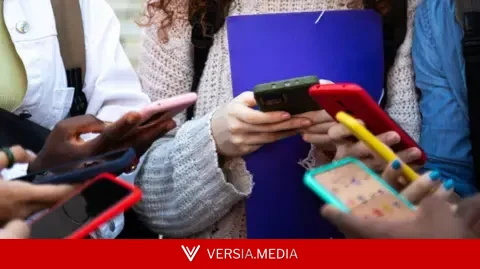
Prime Minister Sir Keir Starmer is anticipated to prohibit under-16s from major social media platforms such as TikTok, Snapchat and Instagram.
The government will also prevent children from livestreaming on "safer" sites and block them from communicating with strangers on gaming applications.
Ministers are evaluating whether to enforce social media curfews for children, though further specifics will not be disclosed until next month.
Australia implemented the world's first comprehensive ban on social media for under-16s in December 2025, and Whitehall sources are characterising the UK's plan, to be revealed by Sir Keir on Monday morning, as "Australia-plus".
"This is a choice about whose side we're on: families across the country, or a status quo that isn't working," Sir Keir stated.
He would, he said, "call time on a system that's failing our kids".
While a government consultation has found that a majority supports a social media ban for under-16s, some campaigners have argued that such sweeping measures would create additional issues.
The Sunday Times reported that the prime minister was set to announce a ban encompassing the same 10 platforms now prohibited for under-16s in Australia: TikTok, Snapchat and Instagram, along with YouTube, Reddit, Twitch, X, Threads, Facebook and Kick.
It indicated that the UK would "go further" than Australia with extra measures, including curfews for older teenagers and restrictions on AI chatbots.
Sir Keir said: "How we keep kids safe online is one of the biggest debates of our time. As a dad, I know every parent wants their child to grow up safe and happy.
"This is a choice about whose side we're on: families across the country, or a status quo that isn't working.
"People rightly expect action, and this government will always stand up for parents and put children first.
"That's why we will call time on a system that's failing our kids and take bold action to give every child the best possible start in life."
Monday's announcement comes two weeks after the government's three-month consultation concluded.
Alongside asking for public views on a complete ban, it proposed less drastic interventions. These included disabling addictive features such as infinite scroll and autoplay, curfews, strengthened age verification, and restricted use of AI chatbots.
There were a total of 116,000 responses to the survey. Some 90% of parents who responded supported a social media ban for under-16s, with more than 83% stating that the benefits of social media were outweighed by the risks.
The father of Molly Russell, who took her own life at age 14 after encountering harmful content online, told the BBC he would be "dismayed" if such bans were implemented, having previously called instead for improved regulation.
Ian Russell warned in January that an Australia-style ban would "create a false sense of safety", push children to other parts of the internet, and deprive them of connection. Organisations including the NSPCC, the Internet Watch Foundation and Childnet supported that message.
Russell told the BBC on Saturday that Sir Keir appeared to have "rushed" his policy for "a political reason".
"If he's playing politics, what he's doing is gambling with young people's lives - and I find that deplorable."
Campaigners like the NSPCC argue that tech giants should be compelled to improve their platforms rather than removing them from children. The companies say they are committed to protecting children.
The culture secretary meanwhile told the BBC's Sunday with Laura Kuenssberg that technology firms had had "more than enough time to get their house in order".
Lisa Nandy said she would not pre-empt Starmer's announcement but stated it was "how, not whether, we better protect children online". She also highlighted the support for a ban during the consultation.
She acknowledged that the ban in Australia had shown some young people would find ways to evade restrictions.
But she said it still created a meaningful cultural change: "At the ages of 8, 9, 10 and 11, children aren't presuming they are going to be in these spaces because all of their friends are."