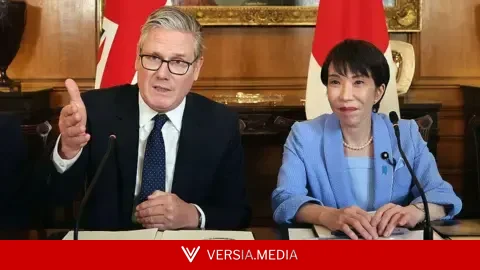
The United Kingdom and Japan have finalized a multibillion-pound investment agreement, which UK Prime Minister Sir Keir Starmer stated will usher in a "new era of co-operation" between the two countries.
Japanese companies are set to invest over £9bn in UK infrastructure and financial services, along with up to £9bn in UK offshore wind projects, resulting in the creation of tens of thousands of jobs, according to Downing Street as the prime minister met with his Japanese counterpart, Sanae Takaichi, in London.
This agreement comes at a time when the UK economy is facing challenges in achieving growth, with analysts forecasting that the US-Israel conflict with Iran will disproportionately impact the UK.
It remains uncertain how much of the investment highlighted by Downing Street constitutes fresh funding versus previously announced initiatives.
On Sunday, Sir Keir and Takaichi convened with Japanese business leaders at Downing Street, with Starmer characterizing the discussions as "very productive".
Separately, Sir Keir expressed he was "really pleased" that both nations had restated their dedication to the Gcap fighter jet program, which is being developed in collaboration with Italy.
Additionally, it was revealed that Rolls-Royce would partner with Japan's Atomic Energy Agency to advance next-generation nuclear technologies, and a technology agreement would connect UK research and development and software expertise with Japanese manufacturing.
Speaking through a translator, Japan's prime minister noted that the UK is "an extremely important partner".
Mitsubishi Estate, Mitsui Fudosan, and Nomura Real Estate were among the Japanese firms that Downing Street stated had committed to spending billions over the next five years on infrastructure and real estate projects.
The Conservative shadow business and trade secretary, Andrew Griffith, stated that his party welcomes "any deal that brings investment" to the UK.
However, he added that Labour's "tax hikes and employer red tape are doing huge damage, destroying jobs and putting more and more people onto welfare".
Although Downing Street has indicated that the deal will enhance jobs and long-term growth, experts anticipate economic hardship in the short term.
The UK economy expanded by 0.6% in the first three months of the year—the fastest growth among G7 economies—but analysts predict sluggish growth in the coming months.
The US-Israel conflict with Iran will impact the UK more severely than any other advanced economy, the International Monetary Fund (IMF) stated last month.
Nevertheless, the IMF expects the UK to rebound, once again becoming the fastest-growing European economy next year within the smaller G7 group of advanced economies, albeit at a slightly reduced growth rate of 1.3%.