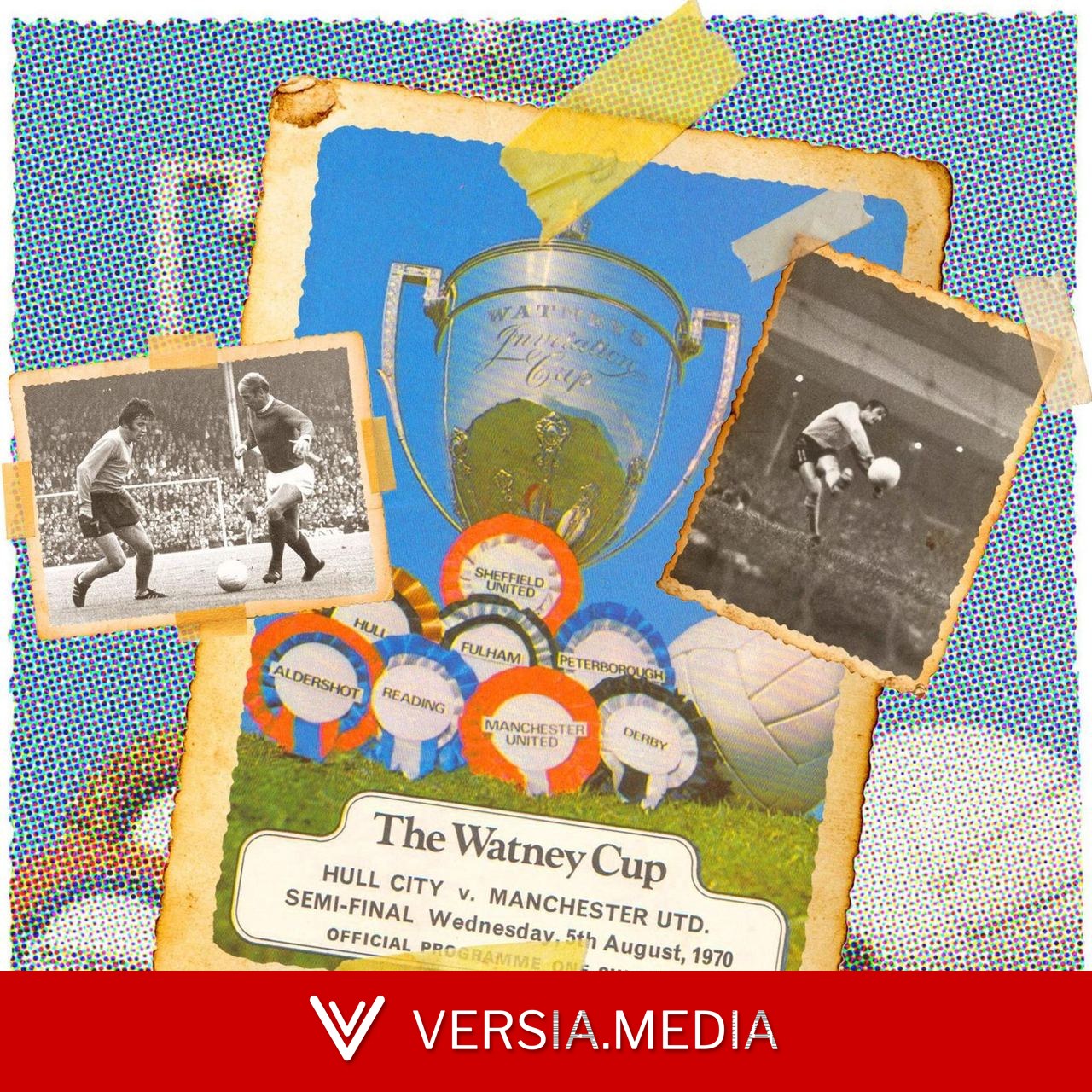
When football turned to penalties to end a 'cruel' system
Published 28 March 2026
Martyn Kelly recalls wishing he had a stool to climb on, just like the other children in the stadium, so he could get a clearer view.
The world’s inaugural official penalty shootout was not something he wanted blocked by other spectators.
On a warm evening on 5 August 1970 at Boothferry Park in Hull, a star-studded Manchester United had finished extra time tied at 1-1 with second-tier Hull City in a cup match.
Six weeks prior, football’s rule-makers had decided to abolish the coin toss for determining winners, replacing it with five players from each side taking a kick from 11 yards out with only the goalkeeper to beat.
"Blimey," thought the then 11-year-old Hull City supporter Kelly. "It's George Best, one of the greatest players ever. He's going to take the first penalty in the world's first penalty shootout."
That was a moment worth witnessing.
No one yet realised that this new method of resolving a drawn football match would become a nerve-wracking ordeal that some fans, players and managers can barely watch.
**First official penalty shootout**
**First official penalty shootout**
The Watney Cup was a pre-season competition from 1970 to 1973 that featured the highest-scoring teams from the top four divisions (with some exceptions)
Before this, cup or knockout matches that ended in draws were resolved through replays, drawing lots, or coin tosses.
At the 1968 European Championship, Italy advanced to the final after correctly guessing heads or tails following a 0-0 draw against the Soviet Union. The final against Yugoslavia then ended 1-1, and Italy eventually won 2-0 two days later when the teams met again for a replay.
For those who were not fans of the existing methods to break a tie, the final straw came four months later.
When Israel’s captain pulled a piece of paper reading 'no' from a large sombrero hat, determining his side had lost their 1968 Olympic quarter-final to Bulgaria after a 1-1 draw, some within his country’s football governing body were outraged.
Israeli Football Association official Yosef Dagan argued there must be a better way to decide these crucial moments – or at least one that was, in theory, less reliant on luck and more on skill.
Dagan and Michael Almog – who later became Israel FA chief – developed the idea of a penalty shootout before submitting an official proposal to Fifa in 1969. It was published in the governing body’s official magazine.
In the letter, Almog proposed "to stop this way of deciding the winner by drawing lots, an immoral and even cruel system for the losing team and not honourable for the winner".
He called for it to be replaced by a shootout of five penalties per side. If the teams were still level after that, it would continue until one side missed and the other scored.
The suggestion was heavily debated before eventually being adopted by football’s lawmakers, the International Football Association Board (Ifab), at its AGM in Inverness on 27 June 1970.
Aside from drawing lots, coin tosses and replays, there had been other methods over the years to settle draws, including sharing titles or counting corners, and there had also been versions of penalty shootouts at some domestic and minor competitions.
When BBC Sport asked Fifa to confirm whether the Watney Cup shootout was the first official penalty shootout, world football’s governing body replied that it does not have "any records confirming or denying the claim".
The National Football Museum, however, refers to it as the first shootout in England.
Various competitions, including the full rounds of the FA Cup until two seasons ago, still continued to use replays. It was not until 1990-91 that the FA Cup introduced penalties if teams were level after extra time in a replay.
After that Ifab decision in 1970, it was not long before the first opportunity arose to see a penalty shootout used to decide a professional football match.
Would the successor to the coin-toss be any less cruel?
That evening in Hull at the Watney Cup – a pre-season cup competition – would provide some answers.
Ian Butler scored Hull City's second penalty
"I couldn't believe it, my beloved Hull City were up against Georgie Best, Bobby Charlton and Denis Law. That's like having Messi, Ronaldo and Mbappe in the same team," Kelly recalled on the BBC's Sporting Witness programme.
Former Hull City player Frankie Banks said: "It was a massive game, playing against Manchester United, who two years earlier had won the European Cup.
"The atmosphere was electrifying.
"The Man United players were our heroes. On paper we didn't stand a chance. We wanted to win, we wanted to prove to everybody that although they were the best side probably in the world we could go out and give them a game."
And that is exactly what they did, taking the lead on 11 minutes through Chris Chilton before Law pulled one back for United in the 78th minute to send the game into extra time. As the clock ticked down on the additional half-hour, players realised they were about to be part of something historic.
"[Hull player-manager] Terry Neill obviously asked for volunteers and some of the lads were reluctant to step up and take the penalties and some were brave enough to step up and say 'I'll take one, I'll take one and I'll take one'," said Banks, who was not on the team sheet that day but was at the game.
"Nobody wants to be the one that misses."
And, in particular, no one wants to be the first player ever to miss in a shootout.
However, Best was happy to go down as the first player to score, sending his right-footed shot low into the left corner.
For Hull City, Neill became the first player-manager to score in a shootout, helping keep the score level at 3-3.
"It was still anybody's game and the noise was deafening," said Banks.
But then, in a moment that countless big-name players to come would experience through the decades, Law saw his low shot saved by a diving Ian McKechnie.
"For ever and ever, Law will go down as the first man to miss in a penalty shootout and McKechnie will go down as the first goalkeeper to save a penalty in a penalty shootout," said Banks.
Ken Wagstaff then missed for Hull and so when Willie Morgan scored for United, Hull knew they had to convert their final kick.
And that was when McKechnie became the first keeper to take a penalty in a shootout.
"Please, not him," Kelly remembers thinking. "I couldn't believe it, my mum couldn't believe it, even Alex Stepney the Man United keeper couldn't believe it and actually asked him what he was doing up there. I had my head in my hands!"
McKechnie stepped up and blasted a powerful strike... against the upper side of the crossbar. And with that, he became the first keeper to miss a penalty in a shootout.
"I still maintain that Ian McKechnie was the right choice – he had a sweet left foot – and he had the guts to do it. I'd have put money on him to score," said Banks.
"Missing that penalty stayed with Ian for the rest of his life."
Ian McKechnie was the first keeper to save a penalty in a shootout
Of course, there have been many Laws and McKechnies since. In fact, statisticians say 24% of penalties in shootouts are missed.
They have settled some of the biggest competitions, with the World Cup final going to penalties three times – in 1994, 2006 and 2022.
The first major international title to be decided on penalties was the 1976 European Championship – with the winning kick the now infamous and audacious chip named after Antonin Panenka .
Over the years, England's men have experienced plenty of misery in shootouts, losing seven times at major tournaments in that way.
Two days ago, Wales' dreams of playing at this year's World Cup were ended by Bosnia-Herzegovina in the now all-too-familiar emotional rollercoaster of a penalty shootout.
But before that night in Hull, no one had known what to expect.
Ten penalties later, they did.
"Each kick was agony," said Kelly.
And more than six decades later, that still stands.
To play this video you need to enable JavaScript in your browser.
This video can not be played
The Panenka penalty
Related topics
Football
Hull City
Insight: In-depth stories from the world of sport
Manchester United