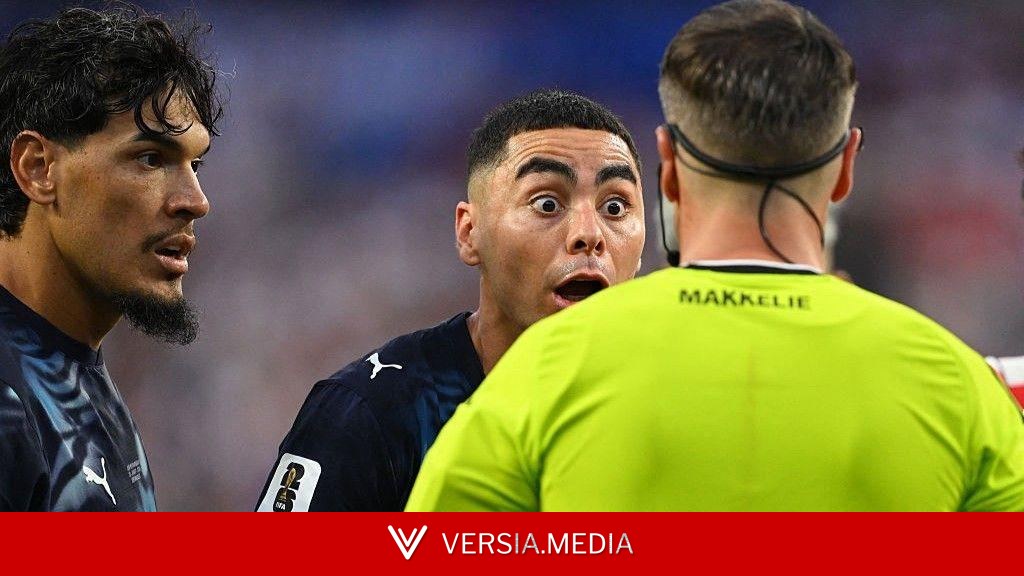
Paraguay forward Miguel Almiron (centre) was taken aback by Danny Makkelie's choice to caution him for simulation during the 4-1 loss to the United States.
Published 13 June 2026
Four matches, three opening ceremonies, triumphs for two of the host nations, and a standout showing in an exciting draw for the third.
Leaving aside concerns about ticket costs and restricted access for referees and players, the World Cup itself has had a fairly positive start.
Now things truly begin to heat up.
Eleven consecutive days featuring four games, followed by three days with six.
As we wrap our heads around the numerous start times, football enthusiasts are dealing with regulation changes that are, in some cases, leaving players, managers, supporters, and television audiences somewhat bewildered.
Here we outline some of those modifications.
VAR, time-wasting, and substitutions - World Cup rule changes clarified Published 4 days ago
VAR, time-wasting, and substitutions - World Cup rule changes clarified
Published 4 days ago
Appropriate outcome, incorrect call?
To view this video you need to activate JavaScript in your browser.
This video cannot be played
VAR steps in for mistaken identity
When Dutch official Danny Makkelie halted the match between the United States and Paraguay early in the second half after Antonee Robinson headed the ball out of the home penalty area, the reason was not immediately obvious.
It emerged that he was being directed to the pitchside monitor by Spanish video assistant referee (VAR) Carlos del Cerro Grande to reassess his call to issue USA captain Tim Ream a yellow card for fouling Paraguay striker Miguel Almiron.
Almiron had not been contacted, so Makkelie withdrew the caution and instead gave it to the former Newcastle player.
It appeared that the adjusted 'mistaken identity' regulation was being applied, and it was welcomed by many observers.
"Good catch and the correct decision, I might add. That's what matters," stated BBC commentator Danny Murphy. "Any rule adaptation that results in diving being penalized is positive."
Except it might not have been the correct decision.
Mistaken identity can only be employed for a particular incident, when the referee "has clearly penalized the wrong player," according to the International Football Association Board (Ifab) wording. "The offence itself cannot be reviewed." Mistaken identity does not seem to cover a situation where an opposing player is incorrectly booked for a dive.
Well-informed sources have informed BBC Sport that Makkelie's call was incorrect, even if it felt right.
Global governing body Fifa has yet to provide clarification.
Former England defender Phil Jagielka fully supports punishing diving.
"I'm a defender, so I'm in favor," he told BBC Sport.
"Things like this, it has to help. Tim Ream gets booked—he could end up being sent off, and he hasn't physically touched anyone.
"It's tough for referees to get every call correct. If something like that occurs, where there's clearly been no contact and it's been faked and the referee has been fooled, why not reverse it?
"The only question is, what happens if I touch you slightly and then you dive? You can't reverse it, because I've touched you, even though my touch didn't cause you to collapse and fall. Where do you draw the line?"
To view this video you need to activate JavaScript in your browser.
This video cannot be played
Could VAR eliminate diving at the World Cup?
'In a quest for perfection, we've ended up with confusion' - analysis
Ifab and Fifa have introduced so many rule changes for this World Cup that it should perhaps be no surprise if referees were to stumble.
On the surface, overturning Ream's yellow card to book Almiron for simulation seemed like a sensible decision. It is the kind of VAR intervention that fans can support.
Throughout the briefings over the past six months, head of referees Pierluigi Collina did not mention diving in connection with mistaken identity.
Collina has been so keen to prevent unfairness that many similar checks have been added. For corners, free-kicks, and second yellow cards, to name three.
In a search for perfection, we have instead wound up with confusion.
This is why there is some speculation that it could be wrong.
Collina introduced the rule change regarding cautions being given to the wrong player for the same offence because, in the Euro 2016 final, France's Laurent Koscielny was booked for handball, but the handball was by Portugal striker Eder. Same offence.
In the USA match, a foul by Ream was corrected to simulation by Almiron. Different offences.
Then there is the fact that the VAR review occurred after the referee had very clearly and intentionally restarted play with a Paraguay free-kick.
Under VAR protocol, a review can take place in two specific cases: mistaken identity and specific red card offences.
But what would have happened if Paraguay had scored from the set-piece?
Fifa appears to be satisfied with the decision, though the restart should have been a dropped ball rather than a free-kick for the United States.
But it goes against what we were told to anticipate from this rule change.
Perhaps Fifa has observed the positive reaction to intervening on simulation and decided to go along with it. A rule change by proxy?
All in all, it is a muddle.
Two halves or four quarters?
USA coach Mauricio Pochettino (right) conveys his message during a hydration break in his team's 4-1 win over Paraguay
When Fifa announced in December that it was introducing mandatory three-minute hydration breaks "regardless of weather conditions," few paid much attention.
After all, it was expected that temperatures would be high and player welfare is a priority.
So far, heat has not been a problem. Three of the opening four matches were played at temperatures just above 20C. Canada's draw with Bosnia in Toronto—which was played in the afternoon—was higher at 26C.
It was similar to temperatures in Chicago last July, when West Ham played Bournemouth in a Premier League Summer Series match, and then-Hammers boss Graham Potter—now in charge of Sweden, who begin their World Cup campaign against Tunisia in Monterrey on Sunday night local time (Monday, 03:00 BST)—was dismissive of the hydration breaks used then.
"I have no idea why there was a water break," Potter said at the time. "Someone needs to explain to me why that was the case. I assumed there wouldn't be one because I came out with a jumper."
Speaking before his team's impressive 4-1 win against Paraguay in Los Angeles, USA coach Mauricio Pochettino was also skeptical about the benefits.
"I don't like it," he said. "I only like it when the conditions are extreme, but when the conditions are good, it is unnecessary."
Coaches are permitted to offer tactical instructions. Ifab rules state that the use of electronic devices is allowed "where it directly relates to player welfare or safety or for tactical/coaching reasons," specifying only that the device must be small.
However, there may be another benefit—a financial one.
It has been noted that broadcasters are using the gaps to air commercials, although US network Fox has been criticized for not returning to the action before the opening game between Mexico and South Africa restarted.
"They're doing it for safety reasons, but in effect we're playing quarters now, which I find strange," said Jagielka.
"It's literally play for 25 minutes and stop for a little break.
"I understand it—there's going to be a lot of football, a lot of minutes. You need to prevent people pulling muscles and allow them to get the hydration in.
"But does it need to be three minutes? How long does it take? It could be a minute."
Whatever the precise reasons for the breaks, and whether they are physically needed or not, Jagielka feels coaches can derive huge benefits from them, especially if a team is underperforming.
"That three minutes could be massive," he said. "If your team's not doing well, and it's a loud stadium, it's nearly impossible to get messages on [to players].
"If you're a manager or coach, you'll be delighted because you can get the lads together and be quickly firing as much information into them as possible.
"I'd say it's more important than half-time. Obviously, at half-time you might be able to show things on a camera or have a bigger view of tactically what's going on, but, especially if your team's not doing great, you could literally turn a game around in that break with what can go on in those three minutes."
Five-second throw-in rule
Fans are beginning to adjust to referees raising their hand and counting down goalkeepers releasing the ball, as the eight-second rule has been in effect since August 2025.
It seems some players have forgotten for this tournament that a five-second rule is being used for throw-ins to accelerate the game.
If a referee believes a player is wasting time, the hand goes up and the countdown starts.
Bosnia-Herzegovina left-back Sead Kolasinac did not react quickly enough in Toronto. Before he took a throw-in, Argentine referee Facundo Tello intervened and awarded Canada a throw.
Related topics
Football
FIFA World Cup 2026
Play BBC Sport's new World Cup predictor game Published 5 days ago
Play BBC Sport's new World Cup predictor game
Published 5 days ago
World Cup fixtures and group standings
World Cup fixtures and group standings
How to watch the World Cup on the BBC Published 6 June
How to watch the World Cup on the BBC
Published 6 June
Everything you need to know about the World Cup Published 1 April
Everything you need to know about the World Cup
Published 1 April