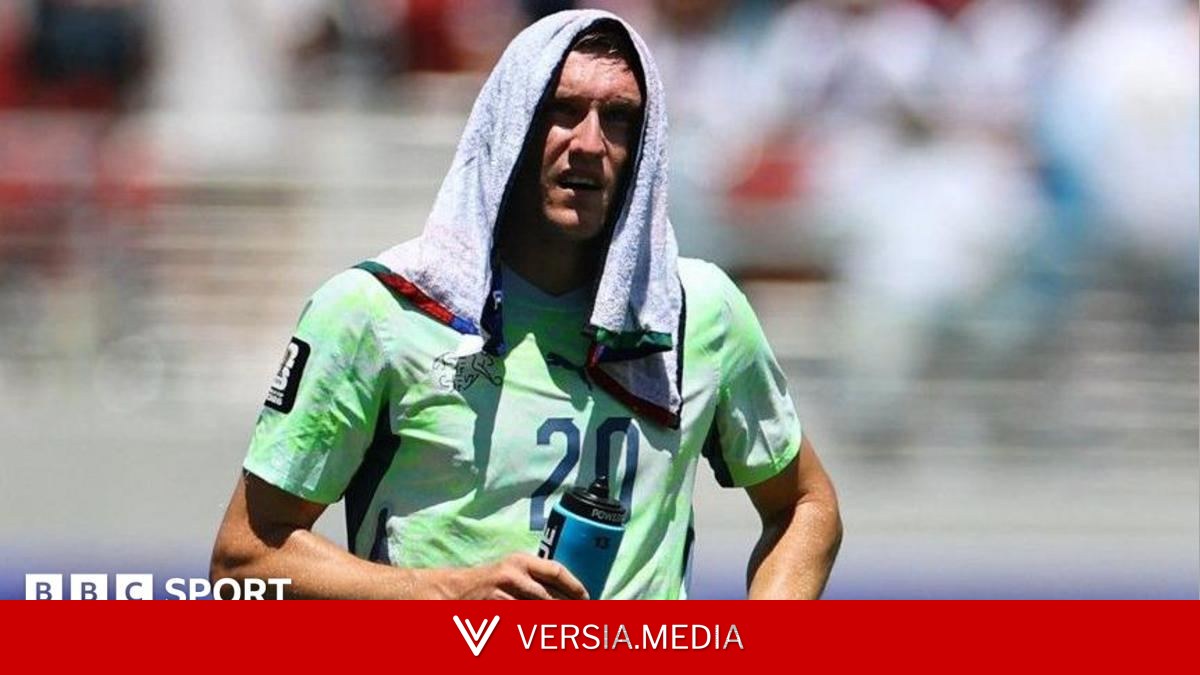
Numerous 2026 World Cup matches played under extreme heat conditions
Published 2 hours ago
A now-familiar sight has emerged at World Cup matches.
The official stops play 22 minutes into each half so players can take on fluids.
A compulsory three-minute hydration pause has been implemented for all 104 games, designed to help players cope with intense heat and humidity across Mexico, Canada, and the United States.
However, not everyone is satisfied.
Some critics have labeled these stoppages as commercial breaks tailored for US broadcasters.
These hydration pauses occur even in stadiums equipped with retractable roofs and indoor climate control.
When asked about the mid-half stoppages in every match, Mauricio Pochettino, head coach of co-hosts USA, remarked: "I'm not a fan. I only support it when conditions are severe.
"But when the weather is fine, it's pointless."
So, who benefits and who suffers from the World Cup hydration breaks? And what impact have they had on the opening fixtures?
Brazil leveled the score against Morocco shortly after manager Carlo Ancelotti used a hydration break to gather his squad and discuss tactics
'Hydration breaks? I refer to them as momentum breaks'
When Brazil's players stopped for water midway through the first half at New Jersey's New York Stadium on Saturday, they were deservedly trailing Morocco 1-0 following a sluggish start.
Just six minutes after the restart, they had equalized.
Admittedly, it came down to a flash of individual brilliance from Vinicius Jr, who cut inside onto his right foot and smashed a superb strike into the roof of the net.
But as Brazil boss Carlo Ancelotti admitted afterward, the hydration pause allowed him to give his players new instructions and adjust the formation.
After being second-best, the five-time world champions suddenly seized momentum.
"You can explain a problem to the players," the Italian coach said later when asked about the benefits of these breaks.
"[You can] make a tactical tweak that can be highly effective."
Carlo Ancelotti gives instructions to his Brazil players during a hydration break against Morocco
If hydration breaks are meant for player welfare, should managers be permitted to give fresh tactical instructions?
United States women's boss Emma Hayes, speaking to ITV Sport, explained that stopping play for a break halted the momentum of the dominant team.
"It benefits the side losing momentum—that's why I call them momentum breaks," she said.
"When you're on top, you don't want it; when you're behind, you do.
"Sometimes it's not even about coaching [during the hydration break]. It's about taking in fluids and settling players. Sometimes it involves doing nothing, but that can still be considered coaching.
"It's unfortunate. I understand it in very hot parts of the country, but it feels like it could become a permanent fixture."
Like Brazil, Canada also equalized shortly after a hydration break—this time in the second half—when substitute Cyle Larin canceled out Bosnia-Herzegovina's lead on Friday.
Scotland scored the only goal in a victory over Haiti shortly after a break, while Australia netted their opener in similar fashion during a 2-0 win against Turkey.
Juan Mata, a World Cup winner with Spain in 2010, said he would have disliked a three-minute pause in each half during his playing days.
"As a player, I don't think it's great," he told ITV Sport.
"When you're losing, you want to score, and when you're winning, you want to keep the ball. I believe they disrupt the momentum."
Morocco head coach Mohamed Ouahbi speaks to Neil el Aynaoui during a hydration break against Brazil
'Another method of inserting adverts'
So, who are the losers, aside from fans who paid high ticket prices expecting fluid, entertaining football—only to see the game halted twice?
Well, World Cup debutants Curacao were in dreamland after equalizing to make it 1-1 against Germany just before a first-half drinks break in Houston on Sunday.
However, the smallest nation ever to compete at the World Cup, by size and population, were not the same after the restart and lost 7-1, as the pause allowed the Germans to regroup.
The Czech Republic dominated the first half against South Korea, but the hydration break abruptly ended that spell of pressure, and they lost momentum after play resumed.
Despite taking the lead, they ultimately lost the match 2-1.
Meanwhile, the Netherlands led Japan 2-1 heading into the second-half hydration break in Arlington, Texas, on Sunday. They failed to hold on and drew 2-2.
Hydration breaks are not always responsible for these momentum shifts, of course.
But as the tournament progresses, it should become clearer whether these interruptions are becoming a significant factor.
Former Arsenal and England forward Ian Wright made his stance on the breaks clear.
"I just think it's another way of inserting adverts from an American perspective," he said.
US broadcaster Fox US overran adverts during a hydration break in the tournament's opening match between Mexico and South Africa.
"They've used the excuse that it's for the players, but it's not for me," Wright added.
While the breaks have their critics, others view them as a positive addition.
"I am always concerned about my players' health. I think it's the right measure—a pause, freshen up, and continue," said Spain boss Luis de la Fuente before his side's opening game against debutants Cape Verde on Monday (17:00 BST).
That match is taking place in Atlanta, where the venue has a retractable roof and climate control.
"Tomorrow, it's cool temperatures in the stadium," De la Fuente added on Sunday.
"Throughout the week, we've seen extreme temperatures. It's very hard to be exposed to such heat for long periods while working.
"In my opinion, the best approach is to drink plenty of water. Take a break, let them breathe for a few seconds.
"It won't be that hot [on Monday], but we need to let them breathe and then have one or two minutes to give them some instructions."
To play this video you need to enable JavaScript in your browser.
This video can not be played
'I have already said enough' on hydration breaks - Van Dijk
Related topics
Football
FIFA World Cup 2026
What is 'Snicko' and how does it work? Published 3 hours ago
What is 'Snicko' and how does it work?
Published 3 hours ago
How thunderstorms and lightning could impact games at World Cup Published 5 June
How thunderstorms and lightning could impact games at World Cup
Published 5 June
Why can't World Cup games kick off on time? Published 21 hours ago
Why can't World Cup games kick off on time?
Published 21 hours ago
From last-chance saloon to World Cup redemption for Potter Published 5 hours ago
From last-chance saloon to World Cup redemption for Potter
Published 5 hours ago
World Cup fixtures and group standings
World Cup fixtures and group standings
How to watch the World Cup on the BBC Published 6 June
How to watch the World Cup on the BBC
Published 6 June