When you purchase through links on our site, we may earn an affiliate commission. Here’s how it works .
Copy link
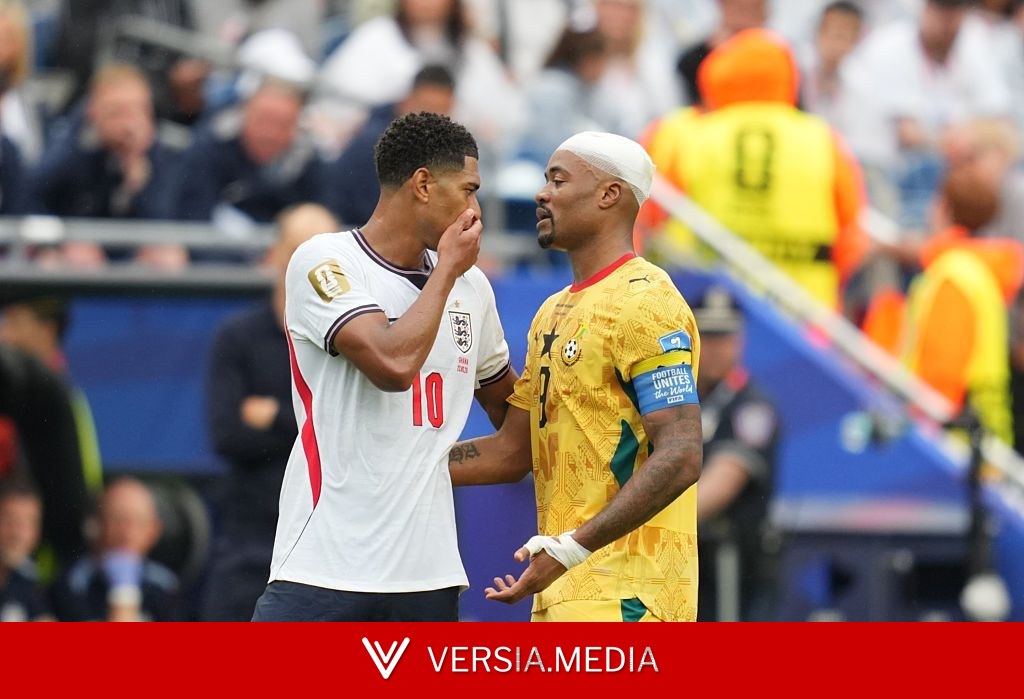
England's Jude Bellingham could be seen to cover his mouth with his hand while talking to Ghana's Jordan Ayew during their goalless draw on Tuesday.
That left some fans wondering why Bellingham avoided a straight red card for covering his mouth, as had previously happened with Paraguay's Miguel Almiron when he did the same while talking to Turkiye's Mert Muldur.
Well, the truth is out there. The difference between the two all comes down to context, as the wording of the rule makes clear.
Play our FREE match predictor and win £1k
An explainer from IFAB - who lay down the Laws of the Game - explained the rule before the Bellingham moment, saying: "At the discretion of the competition organiser, any player covering their mouth when communicating with an opponent in a provocative, derisory or inflammatory manner or situation may be shown a red card and sent off.
"This Law change, which is optional for competitions, reflects the football world’s intention to combat racism and discrimination by introducing meaningful action and a strong deterrent against players covering their mouth (including with their hand, arm or shirt) to prevent the detection of inappropriate comments, insults or other forms of abuse directed at an opponent."
That 'in a provocative, derisory or inflammatory manner or situation' section is key: the rule is not simply a blanket ban on players covering their mouths while addressing opponents.
That is exactly what FIFA's referee chief Pierluigi Collina had wanted the law to achieve.
The best features, fun and footballing quizzes, straight to your inbox every week.
The Italian said before the tournament: "Players can continue to cover their mouth with an arm and the shirt because they may chat with friends.
"It's normal to a chat before, during or after the match - so if the conversation is a friendly conversation, they can continue to do it without any problem.
"When the conversation is confrontational, covering the mouth means that you are doing something very wrong, potentially, and the sanction is the red card."
That was the difference between Almiron's incident and Bellingham's.
The Paraguayan did it while a fracas was unfolding around him following a foul. That is a clear-cut example of provocative or inflammatory situation, and meant a red card was the right call under the rules.
Bellingham's little chat with Ayew was meanwhile clearly friendly in nature, with Ayew putting his arm around Bellingham during the exchange and the pair both sharing a small embrace.
You must confirm your public display name before commenting
Please logout and then login again, you will then be prompted to enter your display name.
1 Why Scotland face last-minute travel chaos if they make it into World Cup round of 32
2 Why are players scoring so many goals at the 2026 World Cup?
3 Quiz! Can you sort these 30 players by their international goals?
4 Quiz! Can you name every player to have won 50 or more caps for Germany?
5 The Big 2006 World Cup Quiz: Can you get 20 correct answers?